
Tools
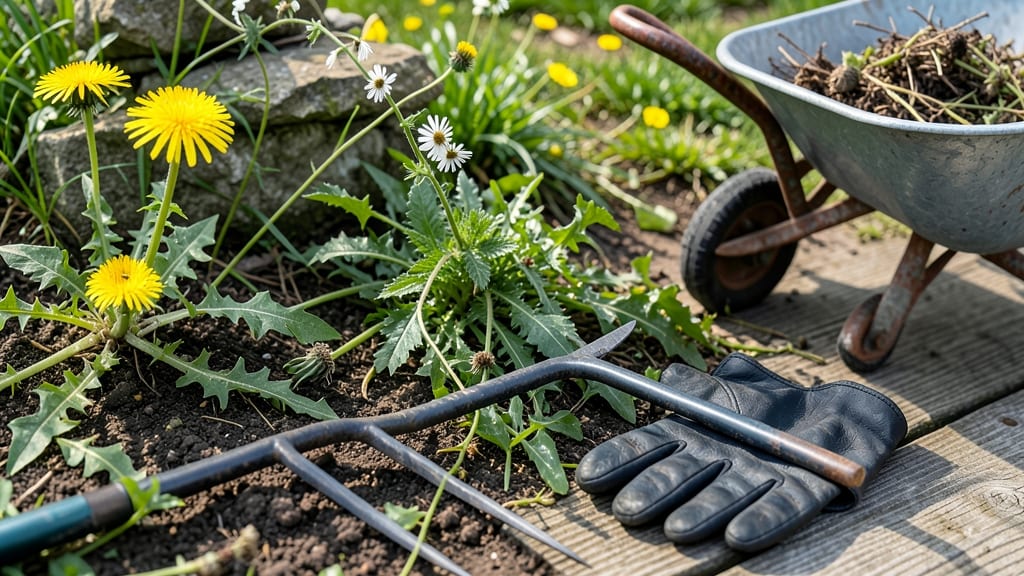
Identifying common garden weeds in the UK means learning to spot broadleaf weeds like groundsel or chickweed alongside grassy types such as annual meadow grass, then examining leaf shapes, growth patterns, and seed heads to distinguish them. Catching them early stops them from taking over your garden.
Weeds in UK gardens often share similar traits, but their leaf shapes and growth habits reveal their true identities. 🌱 For instance, groundsel has jagged leaves with a rosette pattern, while chickweed spreads with tiny, oval leaves and a slightly hairy texture.
Grassy weeds like annual meadow grass grow in dense clumps with narrow, pointed leaves, making them easier to spot once you know what to look for. The key is to observe these details before they flower, as seed heads can complicate identification later.
Seasonal changes also play a role—spring brings fast-growing weeds like speedwell, while autumn sees more persistent types like dandelions. Shady corners often host creeping buttercup, while sunny patches attract broadleaf weeds like plantain. Understanding these patterns helps you time your removal efforts effectively, whether through hand-pulling or targeted herbicides.
💡 In This Article
- Key Characteristics of UK Garden Weeds by Type
- Seasonal Weed Identification Guide for UK Gardens
Key characteristics of UK garden weeds by type
UK garden weeds fall into two main categories—broadleaf and grassy—each with distinct physical traits that make identification easier. Broadleaf weeds like groundsel (Senecio vulgaris) feature jagged, lobed leaves arranged in a rosette pattern at the base, often with a milky sap when crushed.
Their leaves grow up to 5cm wide and have a slightly hairy texture, while their yellow flower heads appear in clusters.
In contrast, grassy weeds such as annual meadow grass (Poa annua) have narrow, pointed leaves with a smooth or slightly rough edge, growing in dense tufts that resemble miniature lawns.
The root systems of these weeds also differ significantly. Broadleaf weeds like chickweed (Stellaria media) have shallow, fibrous roots that spread horizontally, making them easy to pull by hand when the soil is moist.
Their roots rarely exceed 15cm in depth, which is why they resprout quickly if not removed completely. Grassy weeds, however, often develop deeper root systems—annual meadow grass can send roots down to 30cm or more, making them harder to eradicate with shallow tilling or hoeing. 🌱
Growth patterns further distinguish these weeds. Prostrate types like creeping buttercup (Ranunculus repens) spread via long, trailing stems that root at nodes, creating dense mats across garden beds.
Upright weeds such as groundsel grow vertically from a central stem, while creeping species like speedwell (Veronica spp.) form low, sprawling mats with square stems.
These patterns directly influence how you should remove them—upright weeds can often be pulled by the base, while creeping types require careful extraction to avoid leaving root fragments behind.
Seed heads are another critical identifier, though they appear later in the weed's lifecycle. For example, dandelions (Taraxacum officinale) develop their iconic puffball seed heads in spring, while chickweed produces small, star-shaped white flowers that turn into tiny seed pods.
Grassy weeds like annual meadow grass produce seed heads that resemble miniature wheat ears, often turning brown in late summer. Observing these features early—before flowering—can save you time and effort in removal.
Texture plays a subtle but important role in identification. Broadleaf weeds often have leaves with varying degrees of hairiness—groundsel is slightly fuzzy, while plantain (Plantago major) has smooth, ribbed leaves.
Grassy weeds typically feel smoother, though some like couch grass (Elytrigia repens) have a slightly rough edge. These tactile differences can help you distinguish weeds even when visual cues are obscured by soil or debris.
Understanding these characteristics isn't just about spotting weeds—it's about timing your removal. For instance, broadleaf weeds like groundsel are easiest to pull when the soil is damp, while grassy weeds often require targeted spot treatment with a non-selective herbicide like glyphosate.
Knowing whether a weed has deep roots or spreads via runners helps you choose the right method, whether it's hand-pulling, mulching, or chemical control. 💪