
Tools
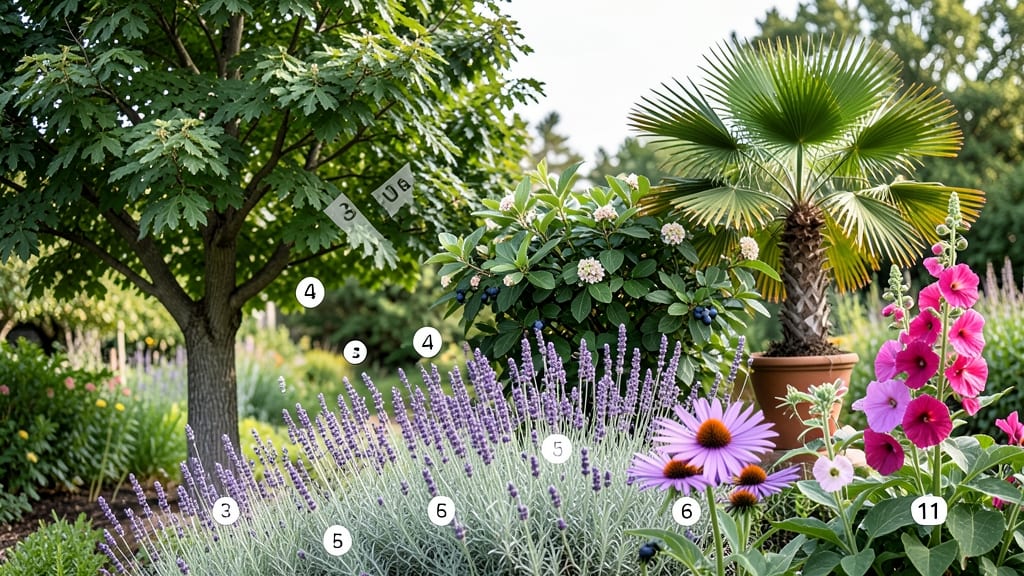
To find your US gardening zones, use the USDA Plant Hardiness Zone Map, which organizes the country into 13 climate-based zones using average annual minimum temperatures and frost patterns. Simply enter your ZIP code to pinpoint your exact zone for precise planting guidance.
Knowing your US gardening zones helps you select plants that thrive in your local climate. The USDA map uses 10°F temperature increments to define zones, meaning Zone 5 (average minimum of -15°F to -10°F) is much colder than Zone 9 (20°F to 30°F).
This system isn't just about frost—it accounts for heat tolerance too, which is why some coastal areas in California are Zone 10 while inland deserts might be Zone 7. 🌱 For example, a tender citrus tree would freeze in Zone 6 but flourish in Zone 9.
What makes this system powerful is its adaptability. While the USDA map provides a baseline, your actual growing conditions might vary due to microclimates—like a south-facing wall that stays warmer or a shaded valley that stays cooler.
That's why many gardeners cross-reference the USDA zone with local agricultural extension reports for hyper-local accuracy. The key takeaway? Your zone is your starting point, but real-world factors often require fine-tuning.
💡 In This Article
- How USDA Plant Hardiness Zones Determine Plant Survival
- Step-by-Step Guide to Locate Your US Gardening Zone
How USDA plant hardiness zones determine plant survival
The USDA Plant Hardiness Zone Map isn't just about labeling regions—it's a scientific tool that predicts plant survival based on average annual minimum temperatures.
Each zone represents a 10°F range, meaning Zone 5 (-15°F to -10°F) has a 50% chance of surviving a -10°F winter, while Zone 9 (20°F to 30°F) can handle only 20°F without damage.
This system accounts for the fact that most plants die when exposed to temperatures 5-10°F colder than their hardiness rating for more than a few hours.
The science behind this involves plant cell freezing. When temperatures drop below 32°F, water inside plant cells begins to crystallize, rupturing cell walls.
Tender plants like tomatoes (Zone 10) lack the protective proteins and sugars that hardy plants (like Zone 3 wheat) produce to prevent ice formation. 🌡️ What's fascinating is how the USDA zones also indirectly account for growing degree days—a measure of heat accumulation that determines when plants mature.
For example, a 140-day tomato variety needs about 1,300 growing degree days above 50°F to ripen, which explains why you can grow tomatoes in Zone 9 but not Zone 4.
Here's where it gets practical: the zones help you avoid costly mistakes. Planting a peach tree (Zone 5-8) in Zone 3 means it'll likely die in winter, while a blueberry bush (Zone 3-7) thrives in both.
The map also explains why some plants have multiple zone ratings—like roses, which can be Zone 3-9 depending on the variety.
What most gardeners overlook is that the USDA zones are 30-year averages, so climate change is gradually shifting these boundaries northward by about 1-2 zones per decade in some regions.
Microclimates add another layer of complexity. A south-facing wall can create a Zone 8 microclimate in a Zone 5 yard, while a low-lying area might experience Zone 4 conditions.
This is why gardeners in transitional zones (like Zone 6b/7a) often use season extension tools—like cold frames or row covers—to protect tender plants. The key insight?
While the USDA map gives you a baseline, your actual growing conditions might require zone adjustments of ±1-2 zones depending on your specific location within the zone.
Consider this real-world example: In Denver, CO (Zone 5b), you can grow potatoes (Zone 3-8) but might struggle with sweet potatoes (Zone 9-11) unless you use black plastic mulch to raise soil temperatures.
Meanwhile, in Miami, FL (Zone 10b-11a), frost is rare, but hurricane winds create their own growing challenges. The zones don't tell the whole story—they're your foundation for understanding what's possible in your climate.
For advanced gardeners, understanding the USDA's "A" and "B" subdivisions matters too. Zone 6a (-10°F to -5°F) is colder than 6b (-5°F to 0°F), which affects which perennial flowers will survive.
This precision helps explain why a daylily (Zone 3-9) might die in Zone 6a but thrive in 6b. The deeper you dive into these distinctions, the more you'll appreciate how temperature nuances shape your gardening success.