Light Requirements
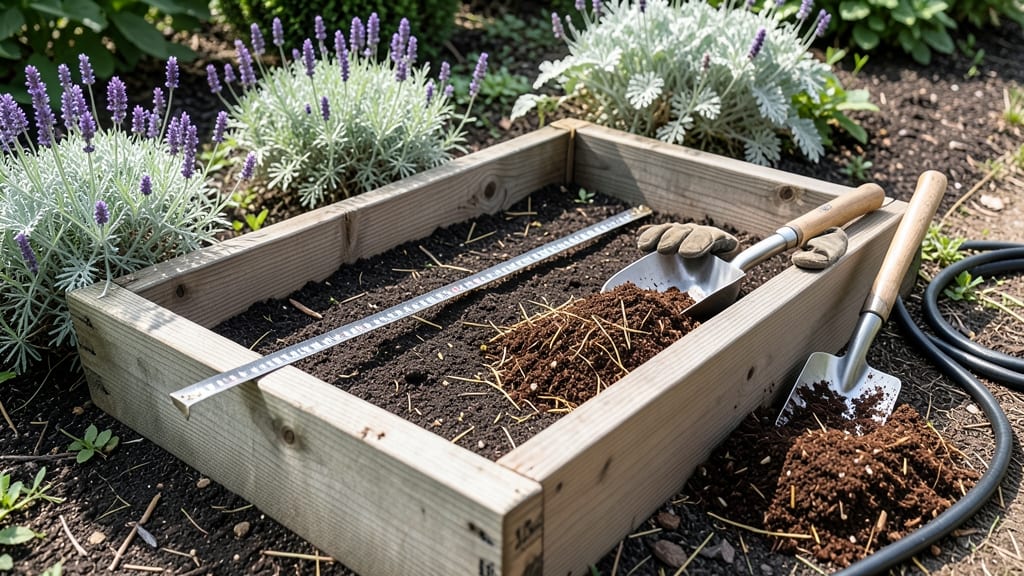
Filling a raised garden bed with the right amount of soil means calculating depth and volume to match your plants' needs—whether you're growing deep-rooted veggies or shallow herbs.
Picture this: You've spent hours building your perfect raised bed, only to realize halfway through filling it that you either have too much soil piling up or not enough to reach the ideal depth.
Avoiding that headache starts with knowing exactly how much soil your bed needs—and which plants require extra room to thrive.
Most vegetables need at least 12 inches of soil to grow strong roots, while herbs and flowers can do well with just 6-8 inches. But depth isn’t the only factor—soil type, drainage, and even your bed’s dimensions play a role in creating the perfect growing environment.
Let’s break down how to measure it right so your plants get the space they deserve.
In this guide, you’ll learn how to calculate soil volume based on your bed’s size, adjust for different plant types, and mix the right soil blend for drainage and nutrients. No more guesswork—just a foolproof method to fill your raised bed like a pro.
Raised garden bed soil depth calculator by plant type (with exact measurements)
Determining the right soil depth for your raised garden bed starts with understanding your plants' root systems. Deep-rooted vegetables like tomatoes and carrots need at least 12-18 inches of loose, fertile soil, while shallow-rooted herbs like basil or thyme thrive with just 6-8 inches.
The key is balancing depth with your bed’s dimensions to avoid overfilling or leaving roots cramped.
Most gardeners make two critical mistakes: underestimating soil volume based on bed height or using heavy clay soil that compacts over time. Instead, focus on root zone depth and soil aeration.
For example, a 4'x8' bed filled to 12 inches requires 1.33 cubic yards of soil—about 36 cubic feet. Let’s break down the exact measurements for common plant types to help you calculate precisely.
Here’s the golden rule: Multiply your bed’s length × width × depth (in feet) to find cubic feet of soil needed. Then convert to cubic yards by dividing by 27.
For a 4'x4' bed with 12" depth, that’s 2.67 cubic feet (0.1 cubic yards). Adjust for your plants’ needs using the table below.
For a 4'x8' raised bed, aim for 12-18 inches of soil if growing a mix of vegetables. If your bed is only 6" deep, limit it to herbs or shallow flowers.
Pro tip: Use a soil moisture sensor to monitor drainage—compacted soil can suffocate roots even if depth looks right.
Another common mistake? Forgetting to account for landscape fabric or hardware cloth at the bottom. These add 1-2 inches to your total depth. Always measure from the bed’s base to the top edge to avoid overfilling.
For example, a 10" deep bed with 1" of fabric means only 9" of soil fits.
Soil type matters just as much as depth. A mix of 60% topsoil, 30% compost, and 10% perlite ensures drainage while retaining moisture. For sandy soils, add 20% coconut coir to improve water retention.
Test your soil’s pH—most vegetables prefer 6.0-7.0, while blueberries need 4.5-5.5. Adjust with lime or sulfur as needed.
Let’s say you’re planting a 4'x4' bed with 12" depth for tomatoes and peppers. Multiply 4×4×1 (converted to feet) = 16 cubic feet. Divide by 27 to get 0.59 cubic yards—about 1.5 cubic yards if rounding up for compost.
Order 1 yard of topsoil and 0.5 yards of compost to mix on-site.
For container gardens or small beds, pre-mixed bags of soilless potting mix work well, but avoid them for deep-rooted plants. Instead, blend garden soil with aged manure or worm castings for nutrients.
If your bed has poor drainage, add a 2-3 inch layer of gravel at the bottom before soil.
Finally, consider seasonal adjustments. In winter, roots may need extra depth for insulation, while summer heat can dry out shallow beds faster. Mulch with straw or wood chips** to retain moisture and regulate temperature. With these measurements, your raised bed will be ready for planting—no guesswork, just growth!
How to calculate soil volume for your raised bed (step-by-step guide)
Calculating the exact amount of soil for your raised bed starts with measuring its dimensions—length, width, and depth. For example, a 4-foot by 8-foot bed with 12 inches of soil depth won’t need the same volume as a 2-foot by 6-foot bed with 6 inches of soil.
The key is converting these measurements into cubic feet, which tells you how much soil to buy or mix. Skip this step, and you might end up with a half-empty bed or a mountain of leftover soil that won’t fit.
Once you’ve measured your bed, the next step is adjusting for the type of plants you’re growing. Deep-rooted vegetables like tomatoes or carrots need at least 12-18 inches of soil, while shallow-rooted herbs like basil or thyme thrive in just 6-8 inches.
Even the soil mix matters—adding compost or perlite changes the volume slightly, so we’ll account for that too. Let’s walk through the exact steps to avoid over- or under-filling your bed.
Step-by-Step Soil Volume Calculator
- 1 Measure Your Bed Dimensions 📏
-
2
Convert Depth to Feet
📐
Example: 12 inches = 1 foot
-
3
Calculate Volume in Cubic Feet
📊
Formula: Length (ft) × Width (ft) × Depth (ft) = Cubic Feet
-
4
Adjust for Soil Mix
🌱
Tip: Add 10% extra for compost/perlite
-
5
Buy or Mix Soil
🛒
Pro Tip: Buy 5-10% more than calculated
Let’s say you have a 4-foot by 8-foot raised bed and want to fill it with 12 inches of soil for growing tomatoes. First, convert 12 inches to feet (1 foot), then multiply: 4 × 8 × 1 = 32 cubic feet of soil.
If you’re mixing your own soil with 30% compost, add 10% extra (about 3.5 cubic feet) to account for the bulkier compost. This gives you a total of roughly 35.5 cubic feet of soil mix to create.
One common mistake is ignoring the settling factor—new soil can compact over time, especially if you water it before planting. To avoid running short, always buy or mix 5-10% more soil than your calculation.
For example, if your math says 32 cubic feet, round up to 36 cubic feet to ensure you have enough after settling. This small adjustment saves you from a last-minute trip to the garden center.
For a quick reference, here’s a cheat sheet for common raised bed sizes: - 2×4 ft bed with 6" soil = 4 cubic feet - 4×8 ft bed with 12" soil = 32 cubic feet - 3×6 ft bed with 10" soil = 15 cubic feet These numbers assume standard topsoil—adjust if you’re using a lighter mix with perlite or heavier compost.
Always double-check your measurements to avoid over- or under-filling.
Once you’ve calculated your soil volume, the next step is choosing the right mix. A 60% topsoil, 30% compost, and 10% perlite blend works for most vegetables, while herbs might prefer a lighter mix with more perlite for drainage.
Pro tip: Layer the soil mix in your bed to ensure even distribution and prevent compaction at the bottom. With the right volume and mix, your raised bed will be ready for planting in no time!