
Companion Plants
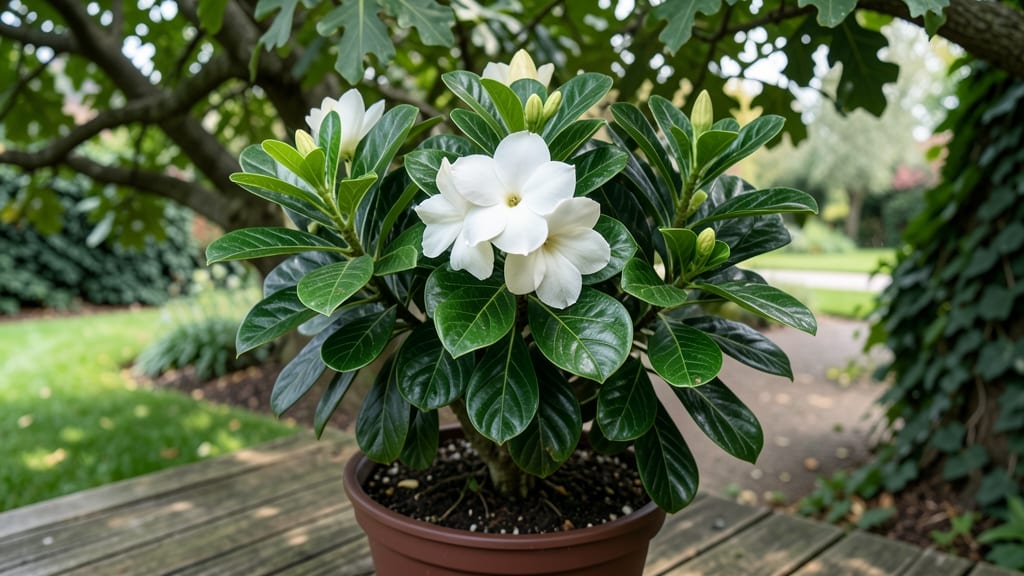
Gardenias typically display soft, elegant colors—primarily pure white to pale cream—with occasional delicate blush or ivory undertones that intensify in sunlight. Their petals often feature subtle veining that creates a luminous, almost ethereal glow.
These flowers are famous for their pristine white blooms, which result from their low anthocyanin content—a pigment responsible for red/purple hues in many flowers. 🌸 The creamier tones appear when gardenias receive more sunlight, as chlorophyll in the petals interacts with light.
Interestingly, while pure white is the standard, rare color mutations can produce pale pink or yellowish blooms, though these are uncommon in nature.
If you're growing gardenias and want to enhance their natural colors, focus on providing bright but indirect sunlight (at least 4-6 hours daily) and maintaining a slightly acidic soil pH (around 6.0-6.5). Overwatering or nutrient deficiencies can cause yellowing, which dulls their signature luminosity.
For the deepest, most vibrant whites, avoid fertilizers high in nitrogen—they promote leaf growth at the expense of flower color intensity.
💡 In This Article
- Gardenia Flower Color Science: Why Most Are White
- How to Enhance Gardenia Bloom Colors in Your Garden
Gardenia flower color science: why most are white
The dominant white color of gardenias stems from their unique pigment chemistry. Unlike many flowers that rely on anthocyanins (red/purple pigments) or carotenoids (yellow/orange pigments), gardenias produce very little of these compounds. Their petals contain high levels of flavonoids and chalcones, which scatter light differently—creating that pure white appearance.
This lack of pigmentation isn't just random; it's an evolutionary adaptation. White flowers often attract pollinators like moths and butterflies that are most active at night or in low light conditions, which is when gardenias typically bloom in their native tropical habitats.
What we perceive as "white" can actually range from pure white to pale cream depending on light conditions. In direct sunlight, gardenia petals often develop subtle ivory or blush undertones because chlorophyll (the green pigment in plants) interacts with light.
This creates a soft gradient effect where the petals appear brighter at the edges and slightly warmer near the center. 🌸 The famous veining you see in gardenias comes from concentrated flavonoids that reflect light differently along the petal's vascular structure, adding texture to their appearance.
Interestingly, gardenias grown in shaded conditions tend to produce more uniformly white blooms, while those in full sun develop richer cream tones.
The science gets even more fascinating when we look at rare color mutations. While pure white is the standard, gardenias occasionally produce pale pink or yellowish blooms due to genetic variations that increase anthocyanin or carotenoid production.
These mutations are extremely rare in nature—occurring in less than 0.1% of gardenia plants—but have been selectively bred in some ornamental varieties. The pink hues come from increased anthocyanin levels, while yellowish tones result from higher carotenoid concentrations.
These color variations often appear less vibrant than pure whites because the additional pigments create more light absorption rather than reflection.
Temperature also plays a subtle role in gardenia color expression. Cooler night temperatures (around 60-65°F) during flowering can enhance the brightness of white blooms by slowing down pigment degradation. Meanwhile, warmer growing conditions (above 80°F) may cause some yellowing at the petal edges due to increased chlorophyll activity.
This is why gardenias grown in tropical climates often have the most consistently pure white flowers—their stable temperatures prevent pigment fluctuations. The same principle explains why indoor gardenias sometimes develop slightly off-white tones if exposed to artificial lighting with inconsistent color temperatures.
For gardeners who want to maximize that signature white glow, understanding these factors is key. The most vibrant whites come from plants that receive consistent light without extreme temperature swings.
Even small variations in growing conditions can shift a gardenia's color from pristine white to a softer cream or pale blush. This explains why some gardenia varieties—like the 'Kleim's Hardy'—maintain their white purity even in less-than-ideal conditions, while others like 'Radicans' may show more color variation depending on their environment.