
Pests
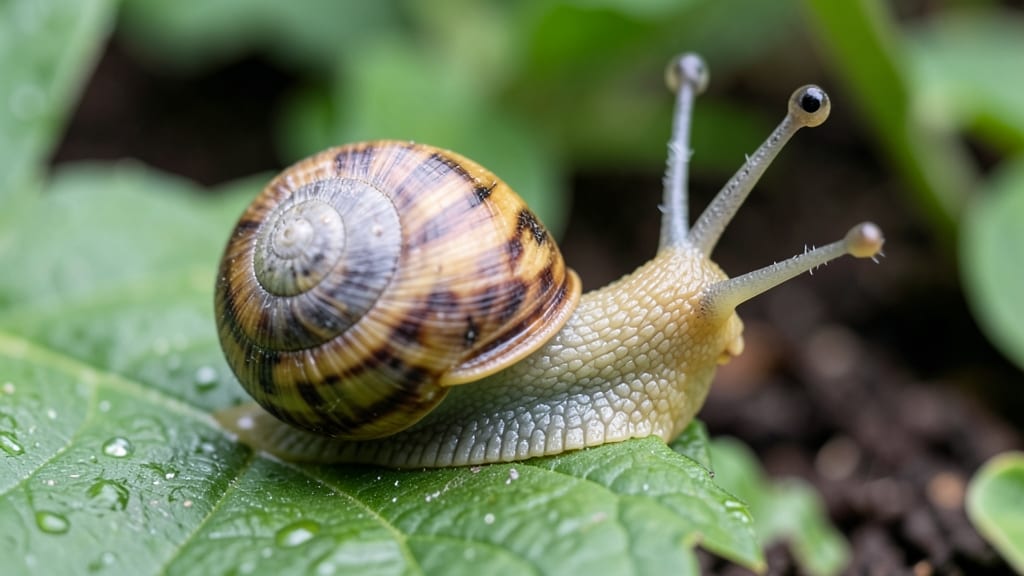
Understanding garden snail anatomy reveals their spiral shell for protection, muscular foot for slow movement, retractable eyes and tentacles for sensory detection, and a radula for scraping plant surfaces. Their internal systems include a heart, lungs, and digestive tract perfectly adapted to their herbivorous lifestyle.
Garden snails have evolved some fascinating adaptations that make them both effective garden pests and resilient survivors. 🌱 Their radula—a toothed tongue-like structure—acts like a rasp, allowing them to scrape through tough plant leaves with surprising efficiency.
The muscular foot secretes mucus to reduce friction while moving, while their eyes on stalks provide 360-degree vision to detect predators from any angle. Even their spiral shell isn't just for show; it doubles as a portable fortress they can retreat into when threatened.
Their internal anatomy is equally specialized. Unlike many creatures, garden snails breathe through a pulmonary cavity rather than gills, making them vulnerable to drying out—a fact that explains why they're most active during damp conditions.
Their open circulatory system pumps blood through a simple heart and into a hemocoel, distributing nutrients efficiently despite their slow pace. This combination of external and internal features makes them both fascinating to study and challenging to control in garden settings.
💡 In This Article
- How Garden Snail Body Parts Work Together for Survival
- Identifying Garden Snail Anatomy for Pest Control
How garden snail body parts work together for survival
The garden snail's radula is one of nature's most efficient plant-scraping tools—a ribbon-like structure lined with thousands of tiny, chitinous teeth arranged in rows. These teeth, numbering around 14,000 in a single radula, can regenerate if damaged, allowing the snail to continuously feed on leaves, stems, and even soft fruits.
The radula's scraping action creates microscopic grooves in plant surfaces, breaking down cellulose fibers into a slurry that's easier to digest. 🌿 This specialized feeding mechanism explains why garden snails can devour entire lettuce leaves overnight, leaving only the toughest veins behind.
Their muscular foot, which covers about 70% of their body surface, serves as both a locomotion system and a moisture regulator. The foot secretes a layer of mucus containing glycoproteins that reduce friction while allowing movement on rough surfaces.
This mucus also helps maintain hydration—a critical adaptation since snails can lose up to 10% of their body weight to evaporation in dry conditions.
The foot's wave-like contractions create a crawling motion, with the snail leaving behind a silvery trail that can stretch up to 3 times their body length in a single night's movement.
The retractable eyes and tentacles provide a 360-degree sensory advantage. Each eye sits atop a long, flexible stalk that can independently rotate, giving the snail panoramic vision without moving its head.
These tentacles contain light-sensitive cells and chemoreceptors, allowing them to detect movement, humidity changes, and even vibrations in the soil. 👁️ The upper pair of tentacles (the longer ones) are primarily for vision, while the shorter lower pair detect chemical cues.
This dual sensory system helps them avoid predators like birds and frogs while locating food sources in low-light conditions.
The spiral shell isn't just protective—it's a physiological marvel that regulates moisture and temperature. The shell's coiled structure creates a larger surface area relative to volume, which helps prevent rapid dehydration.
When threatened, the snail retracts completely, sealing the shell opening with a layer of mucus that hardens into a temporary barrier. This shell also doubles as a calcium reservoir; during breeding season, snails may even reabsorb shell material to strengthen their eggs.
The shell's weight, typically 60-80% of the snail's total body weight, makes up for their slow movement by providing stability.
Internally, their open circulatory system pumps hemolymph (a blue-green fluid) through a simple heart and into body cavities, delivering oxygen and nutrients efficiently despite their sluggish pace. The pulmonary cavity functions like lungs, drawing in air through a small opening when the snail is active.
This system explains why garden snails are most active after rain—their bodies can absorb moisture through their skin, supplementing their limited water storage capacity. The entire digestive system is adapted for processing high-fiber plant material, with a gizzard that grinds up ingested debris using ingested sand particles.
What's most remarkable is how these features work in harmony. The radula's scraping creates entry points for enzymes to break down plant matter, while the foot's mucus trail preserves moisture for the digestive process.
The sensory tentacles guide the snail toward optimal feeding conditions, and the shell provides both protection and physiological support. This integrated system makes garden snails surprisingly resilient pests, capable of thriving in diverse environments from tropical gardens to temperate climates. 🌍