
Light Requirements
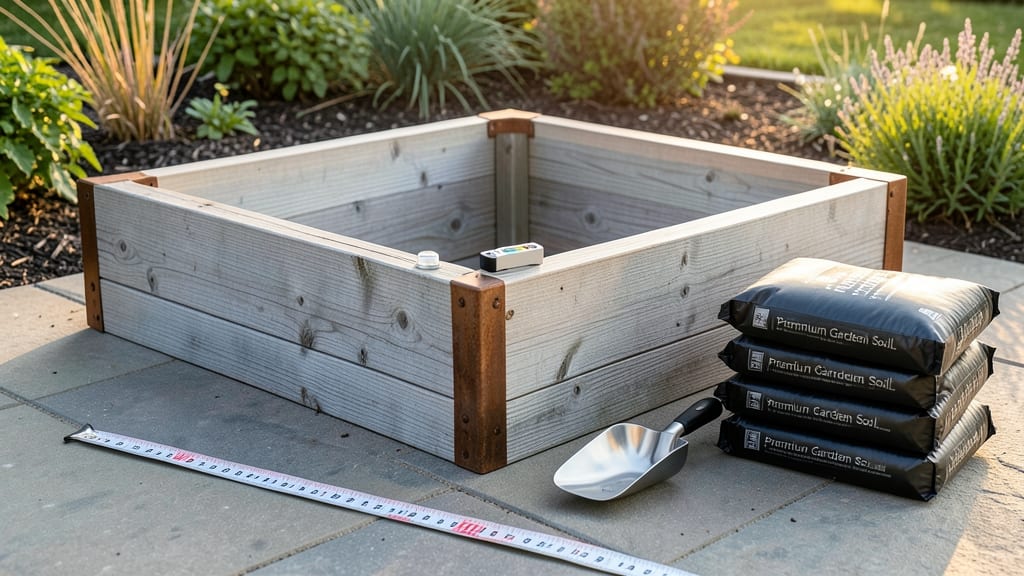
To determine how much dirt you need for your raised garden, multiply its length by width by depth (in feet) for cubic feet, then add 10-20% extra for settling. A 4’x8’ bed with 12” depth requires roughly 32 cubic feet of soil mix.
Calculating your raised garden's soil needs starts with simple math: length × width × depth (all in feet). 🌱 For example, a 4’x8’ bed filled to 1 foot depth needs 32 cubic feet of soil, but most gardeners aim for 12" depth (1 foot), so the math stays straightforward.
The extra 10-20% accounts for soil settling over time—critical for long-term plant health. If your bed has irregular shapes, break it into rectangles first to simplify calculations.
Beyond volume, soil quality matters just as much. A mix of 60% topsoil, 30% compost, and 10% perlite creates ideal drainage while retaining moisture. For flower beds, you might reduce perlite to 5% and add more compost for nutrient-rich growth.
Always test your soil's pH before planting—most vegetables thrive in 6.0-7.0 range, while blueberries need 4.5-5.5. 💫
💡 In This Article
- Calculating Raised Garden Soil Volume by Dimensions
- Best Soil Mix Ratios for Raised Garden Beds
Calculating raised garden soil volume by dimensions
Understanding how to calculate your raised garden's soil needs starts with the basic cubic foot formula: length × width × depth. This simple multiplication gives you the volume in cubic feet, which directly translates to how much soil your bed will hold.
For example, a standard 4’x8’ raised bed filled to 12” (1 foot) depth requires 32 cubic feet of soil—just multiply 4 × 8 × 1.
Depth is where many gardeners make mistakes; while 12” is common for vegetables, deeper beds (like 18” or 24”) need significantly more soil—48 or 64 cubic feet, respectively—because deeper roots demand richer, looser soil for optimal growth. 🌱
The depth of your raised bed isn’t just about volume—it’s also about root space and drainage. Most vegetables thrive in 12-18” of soil, but heavy feeders like tomatoes or squash benefit from 24” depth to support their sprawling roots.
Circular or keyhole-shaped beds complicate calculations, so break them into rectangular sections or use the formula for a circle’s area (πr²) before multiplying by depth. For instance, a 5-foot-diameter circular bed with 12” depth needs about 24 cubic feet of soil—calculated by π × (2.5)² × 1.
Always round up to account for uneven edges or slight overfill.
Soil settling is the silent thief of garden volume. When you first fill your bed, the soil may appear fluffy, but over time, it compacts naturally—especially after watering or foot traffic. That’s why experts recommend adding 10-20% extra soil beyond your initial calculation.
For our 4’x8’ bed, that means ordering 36-38 cubic feet instead of 32. This buffer ensures your plants have enough room to grow without the soil collapsing around their roots.
Pro tip: Use a soil moisture meter to check compaction—if the soil feels dense after a few weeks, add a 2-3” top layer of fresh compost or coconut coir to restore looseness. 💫
Shape matters more than you might think. Rectangular beds are the easiest to calculate, but keyhole gardens (with a central compost basket) or raised spiral designs require creative problem-solving. For keyhole beds, divide the shape into a rectangle and a semicircle, calculate each separately, then add them together.
A 4’x4’ keyhole bed with 12” depth might need ~35 cubic feet—20 for the rectangle and 15 for the semicircle.
Always measure twice: use a tape measure for length/width and a depth gauge (or ruler) to verify soil levels, as uneven edges can hide gaps where extra soil is needed.
Don’t overlook the weight of your soil choice. A cubic foot of topsoil weighs about 40-50 lbs, while compost or coconut coir is lighter (20-30 lbs).
If your raised bed sits on a wooden frame, ensure your supports can handle the load—8’ beds with 18” depth can weigh over 1,000 lbs when filled!
For heavy soils, consider staggered boards or additional posts to prevent sagging. 🔥 A well-built frame isn’t just about aesthetics; it’s about longevity and stability, especially in windy or rainy climates.
Finally, think about layering for long-term success. Instead of filling your bed all at once, consider a 3-phase approach:
- Bottom layer (6”): Coarse material like gravel or wood chips for drainage (if your bed isn’t on native soil).
- Middle layer (6-12”): A mix of topsoil and compost (70/30 ratio) for root growth.
- Top layer (2-3”): Finishing soil with perlite or coconut coir to retain moisture and prevent crusting.