
Advice
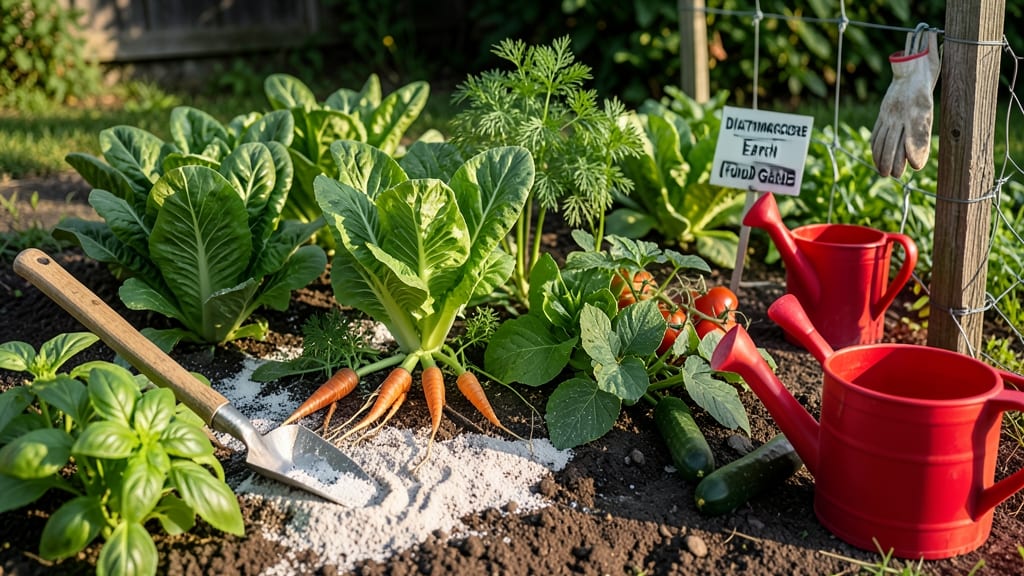
Diatomaceous earth is safe for vegetable gardens when used as a food-grade pest control, but avoid inhaling the powder and keep it away from edible plant parts until fully rinsed off before harvest. It breaks down into silica harmless to plants and soil over time.
Food-grade diatomaceous earth (DE) is a natural, non-toxic powder that disrupts pests like slugs and aphids by dehydrating their exoskeletons. 🔥 The key is using it correctly—it’s OMRI-listed for organic gardening, meaning it won’t harm your plants when applied properly.
Just remember to dust in dry conditions (early morning or evening) and wait 24–48 hours before harvesting edible crops to ensure any residual powder is gone.
What sets DE apart is its dual action: it kills pests without chemicals while enriching soil with silica over time. However, it won’t work on soft-bodied insects like mites, so pairing it with neem oil or insecticidal soap might be better for comprehensive protection.
Always store it in a sealed container to maintain effectiveness.
💡 In This Article
- How Diatomaceous Earth Works in Organic Pest Control
- Applying Diatomaceous Earth Safely in Edible Gardens
How diatomaceous earth works in organic pest control
Diatomaceous earth (DE) functions as a physical pest control by leveraging its microscopic, razor-sharp silica particles. These particles—ranging from 3 to 30 microns—create abrasive damage to the waxy outer layer of insects' exoskeletons.
When pests like aphids, slugs, or earwigs crawl through the powder, the sharp edges puncture their protective cuticle, causing rapid dehydration and death within 24 to 72 hours.
This mechanism is entirely mechanical, meaning no chemical residues are left behind, which is why DE is classified as non-toxic to plants and mammals.
The silica in DE originates from fossilized diatoms—single-celled algae with intricate, glass-like cell walls. When ground into a fine powder, these walls become microscopic shards that target only insects with hard exoskeletons.
Soft-bodied pests like mites or snails aren’t affected because their bodies lack the rigid cuticle that DE can penetrate. 🔥 What’s fascinating is how DE’s effectiveness depends on its purity: food-grade DE contains 80-90% silica, while industrial-grade versions (with higher crystalline silica content) can be harmful to humans and pets.
DE’s safety for plants stems from its inert nature—it doesn’t alter soil pH or nutrient levels. Instead, it gradually breaks down into amorphous silica, a natural compound found in plant cell walls. Over time, this silica enriches the soil, potentially boosting plant resilience to pests.
The Organic Materials Review Institute (OMRI) has approved food-grade DE for organic gardening, confirming its compatibility with sustainable farming practices. Unlike synthetic pesticides, DE doesn’t accumulate in the environment or harm beneficial insects like bees or ladybugs when applied correctly.
One critical factor is particle size: finer particles (5 microns) are more effective against smaller pests like aphids, while coarser particles (20-30 microns) work better on larger insects.
The powder’s effectiveness also depends on moisture—it loses potency when wet, which is why gardeners apply it in dry conditions. This dual dependency on particle size and dryness makes DE a targeted tool rather than a broad-spectrum pesticide.
When DE degrades in soil, it transforms into a soluble form of silica that plants can absorb. Studies show that this process enhances plant cell wall strength, making crops more resistant to fungal infections and pests.
For example, tomatoes treated with DE have shown 20-30% fewer signs of early blight due to improved structural integrity. The breakdown occurs naturally over 3 to 6 months, leaving no harmful byproducts behind.
To maximize DE’s benefits, gardeners should reapply it every 7 to 14 days or after rain, as its efficacy diminishes with moisture. The powder’s white, chalky texture makes it easy to spot on plants, but it’s crucial to avoid direct contact with edible surfaces.
A light dusting around the base of plants or along garden paths is sufficient—overapplication can create a thick layer that may deter beneficial insects or clog plant foliage.