
Light Requirements
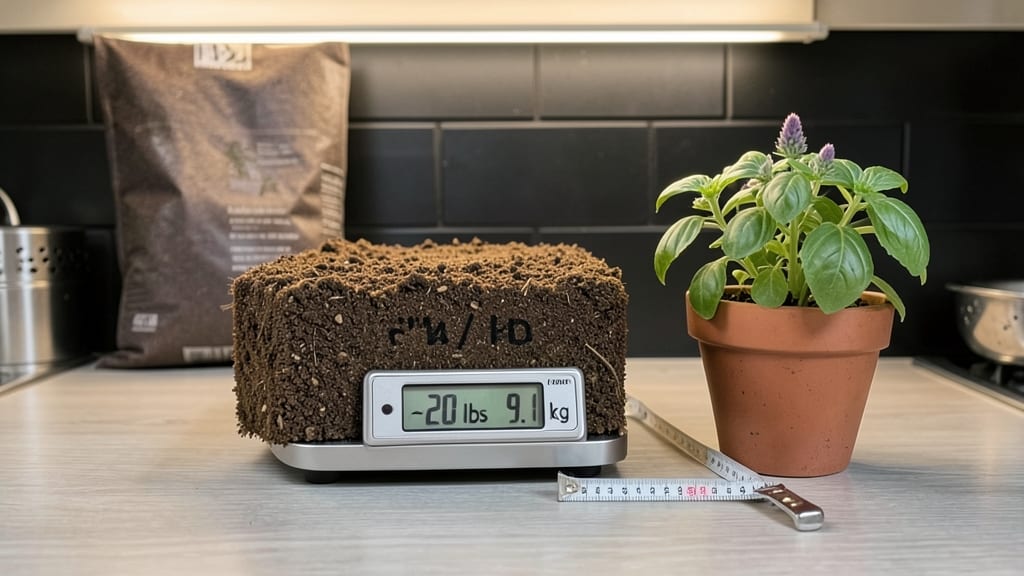
To determine how much 0.75 cubic feet of garden soil weighs, expect a range of 20 to 30 pounds, with variations based on moisture levels, organic content, and compaction—drier loamy soil averages 25 pounds, while heavier clay soil can reach 35 pounds.
Understanding this weight helps with everything from garden bed prep to container gardening. 🌱 The difference between dry and saturated soil can be dramatic—wet clay soil might feel twice as heavy as loose, sandy soil of the same volume.
For accurate planning, I always check moisture levels first, since even a small water change can shift the weight by 5-10 pounds per cubic foot.
This variation matters most when moving soil or calculating how much you'll need for raised beds. A 5-gallon bucket (about 0.375 cubic feet) of dry loam would weigh roughly 10 pounds, while the same volume of wet clay could push 15 pounds.
For heavy lifting, consider breaking tasks into smaller batches or using wheelbarrows with reinforced frames.
💡 In This Article
- Factors Affecting Garden Soil Weight per Cubic Foot
- Practical Ways to Measure and Adjust Soil Weight for Gardening
Factors affecting garden soil weight per cubic foot
Soil weight per cubic foot varies dramatically because it's not just dirt—it's a complex mix of minerals, organic matter, water, and air. The key factor is bulk density, which measures how tightly packed soil particles are.
Sandy soils have larger particles with more air pockets, giving them a bulk density of about 1.4-1.6 g/cm³, while clay soils pack tightly with densities up to 1.8 g/cm³.
This means 0.75 cubic feet (about 21.3 liters) of sand might weigh 28-32 pounds, but the same volume of clay could hit 35-40 pounds when saturated.
Moisture content creates the biggest swings. Dry loam soil (ideal for gardening) typically weighs 25 pounds per 0.75 cubic feet, but when fully saturated, that weight can jump to 35 pounds or more. The reason?
Water fills the pore spaces between particles, adding 0.62 pounds per cubic inch of water. For example, a 12-inch-deep garden bed (0.75 cubic feet) might hold 5-10 pounds of water during heavy rain, doubling the total weight.
Organic matter like compost adds another layer—it's lighter than minerals but holds water like a sponge, further complicating weight estimates.
Particle size distribution plays a hidden role too. Silt particles (0.002-0.05mm) create a sticky, dense matrix when wet, while sand (0.05-2mm) stays loose. Here's how it breaks down for 0.75 cubic feet:
- Pure sand: 28-32 pounds (low organic matter, high air space)
- Loamy soil: 20-28 pounds (balanced organic/mineral mix)
- Clay-heavy: 30-40 pounds (tight particle packing, water retention)
Compaction from foot traffic or machinery crushes air pockets, increasing density. A lightly trodden garden path might compact soil to 1.6 g/cm³, while a heavily used area could reach 1.9 g/cm³. The result?
The same 0.75 cubic feet could weigh 30 pounds dry in one spot but 38 pounds in another. This variation is why professional landscapers use soil cores to test density before major projects.
Temperature also sneaks into the equation. Cold soil holds more water (ice crystals expand in pores), while hot soil loses moisture to evaporation. In summer, 0.75 cubic feet of clay soil might drop from 35 pounds to 28 pounds in just 24 hours.
This seasonal shift explains why spring planting often requires heavier lifting than fall—soil is typically wetter and denser after winter rains.
What most gardeners overlook is the porosity factor. Well-aerated soil with 40-50% air space (like sandy loam) feels lighter than compacted soil with 20% air (like clay). Think of it like packing a suitcase: loose clothes weigh less than tightly packed ones.
For 0.75 cubic feet, this difference can mean 5-10 pounds of variation in real-world handling.